
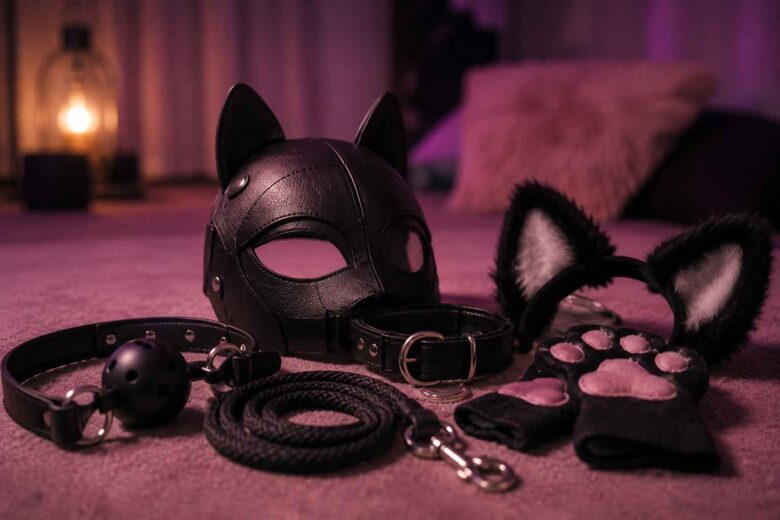
Pet play is a consensual role-play activity between adults in which one person adopts the behavior or persona of an animal. Actual animals are not involved.
Often associated with BDSM, pet play can include power exchange, training, affection, discipline, care, and role immersion.
Sexual activity may be part of it, but it is not required.
Some participants value pet play for emotional connection, recreation, stress relief, or self-expression.
Animal personas vary widely. Puppies, kittens, and ponies are common, while foxes, rabbits, wolves, fictional creatures, and other personas also appear.
No fixed formula defines pet play.
Common Types of Pet Play
Animal personas often influence behavior, gear, communication, and the type of interaction participants prefer, often addressed as kink.
Different personas can create very different dynamics.
Puppy Play

Puppy personas are often energetic, loyal, playful, affectionate, and responsive to praise.
Pup play has also been studied as a distinct kink and social activity. In a community survey of 733 participants:
- 71.9% identified as pups
- 9.7% as handlers
- 18.4% identified as both
Someone may crawl, fetch toys, follow commands, seek attention, or react enthusiastically to positive reinforcement.
Handlers may introduce simple training exercises, games, collars, leashes, or verbal praise. Some puppy dynamics center on obedience, while others focus more on play and companionship.
Kitten Play

Kitten play often involves a more independent or selective style of interaction.
Someone taking on a kitten persona may be curious, affectionate, mischievous, demanding, playful, or intentionally difficult. Strict obedience is often less important than attitude, attention, and interaction.
- Purring or making other cat-like sounds.
- Seeking affection only at chosen moments.
- Ignoring or testing instructions.
- Playing with small toys or props.
- Switching between closeness and independence.
Kitten play can work well for participants who enjoy playful resistance instead of constant obedience.
Pony Play

Pony play participants may practice posture, walking patterns, commands, grooming routines, pulling exercises, or equestrian-inspired movements. Harnesses, reins, tails, boots, and specialized equipment may also be used.
Training can play a larger role in pony dynamics. Some participants practice repeated routines, presentation, controlled movement, or performance-style activities.
Physical demands can also be higher than in some other forms of pet play, making comfort, conditioning, and safe equipment use important.
Other Pet Play Personas
Pet play is not limited to puppies, kittens, and ponies.
Participants may choose foxes, rabbits, wolves, pigs, bears, or fictional creatures. A persona does not need to copy an animal accurately.
Selected traits, sounds, movements, or behavioral patterns are enough to create the role.
Freedom to choose different personas allows participants to build a dynamic around behavior they actually enjoy instead of following a fixed category.
Why Do People Like Pet Play?
People participate in pet play for many reasons, and sex is only one possible part of the experience.
For some, taking on an animal persona creates distance from everyday responsibilities. For others, pet play creates a structured way to experience trust, care, obedience, affection, or playful behavior.
Escapism and Mental Relief
A pet role can reduce the number of decisions someone needs to make during a scene.
Instead of thinking about work, schedules, chores, or social expectations, a participant may focus on movement, touch, play, commands, or immediate sensations.
Similar effects have been observed in BDSM research.
In a small study involving seven couples, participants reported reduced psychological stress, improved mood, and high levels of flow after consensual BDSM activities.
Pet Headspace
Pet headspace refers to a state of strong role immersion.
Someone in pet headspace may focus less on verbal thought and more on physical sensations, sounds, movement, posture, play, or interaction with a handler.
Certain cues may make that state easier to enter:
| Cue | Purpose |
|---|---|
| Familiar commands | Help create structure and signal the start of the role-play state. |
| Repeated routines | Make the dynamic feel predictable, familiar, and easier to enter. |
| Animal-inspired gear | Supports role immersion through visual and physical cues. |
| Crawling or altered posture | Changes body language and helps reinforce the chosen role. |
| Reduced verbal communication | Can deepen immersion by shifting focus to gestures, sounds, or body language. |
| Familiar praise or training cues | Reinforce the dynamic and help maintain the role-play atmosphere. |
Not every participant seeks pet headspace, and experiences can differ significantly.
Power Exchange and Trust
Power exchange can be part of pet play when one participant accepts guidance or control within agreed limits.
A handler may set rules, give instructions, guide movement, or decide how a training exercise will work. A pet may agree to follow those directions during the scene.
Trust matters because both participants need confidence that limits, stop signals, and prior agreements will be respected.
Research comparing BDSM practitioners with a control group has also found that practitioners scored lower in rejection sensitivity and higher in subjective well-being, alongside differences in traits such as openness and extraversion.
Power does not always mean strict obedience. Some pets deliberately resist, tease, challenge instructions, or act bratty as part of the agreed dynamic.
Self-Expression Through Animal Role-Play
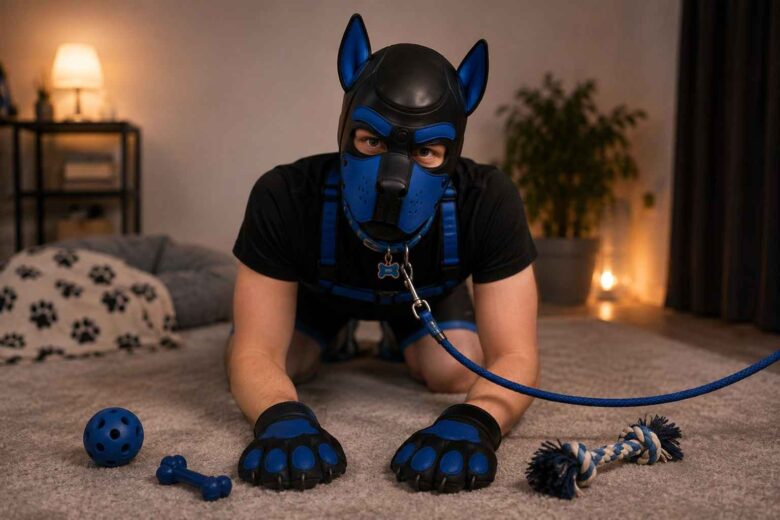
Animal personas can give participants room to behave differently than they do in everyday settings.
Someone who is normally reserved may enjoy becoming demanding or playful.
Someone who carries a lot of responsibility may enjoy following simple instructions. Another person may enjoy acting energetic, needy, mischievous, affectionate, or impulsive.
Role-play can make those behaviors easier to access because they occur within a clearly defined scene.
Pet Play Gear and Accessories
Gear is optional, but it can make an animal persona easier to express and help some participants stay focused on the role.
Common accessories include collars, leashes, ears, tails, paw-style gloves, harnesses, masks, hoods, knee protection, and toys.
- Collars can symbolize a role or relationship.
- Leashes can support walking exercises or controlled movement.
- Ears and tails can make a persona visually recognizable.
- Paw-style gloves can change how someone uses their hands.
- Harnesses can support puppy or pony training activities.
- Knee pads can reduce discomfort during crawling.
- Toys can add games, fetching, tugging, or reward-based activities.
Masks and hoods can have a stronger psychological effect for some participants because they reduce visual cues associated with everyday identity.
Expensive equipment is not necessary.
Basic accessories or no gear at all can work if the role and interaction feel engaging to both participants.
Pet Play Safety, Consent, and Boundaries
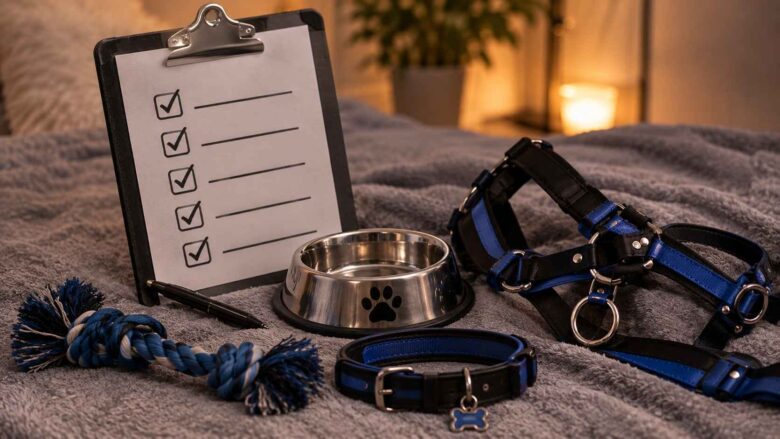
Consent should be discussed before any pet play scene begins.
Research examining consent in BDSM identifies mutual informed consent as a central distinction between consensual BDSM activity and abuse.
Participants should agree on roles, limits, acceptable activities, physical restrictions, communication methods, and anything that is off-limits.
Clear stop signals become especially important when a participant plans to speak less while in character.
Useful safety measures can include:
| Safety measure | Purpose |
|---|---|
| Safeword for stopping immediately | Gives either person a clear way to stop the activity at once. |
| Separate word for slowing down or checking in | Allows a pause or adjustment without fully ending the activity. |
| Hand signal when speaking is difficult | Provides a nonverbal way to communicate discomfort or the need to stop. |
| Object that can be dropped as a stop signal | Creates a simple physical signal when words or gestures are not easy to use. |
| Regular verbal or nonverbal check-ins | Helps both people confirm comfort, consent, and emotional safety during the activity. |
Gear should never block breathing or make it impossible to communicate distress.
Masks and hoods need adequate airflow. Collars and harnesses should fit correctly and avoid dangerous pressure. Leashes require caution, especially when attached around the neck.
Crawling can strain wrists, knees, ankles, and backs. Padded flooring, knee protection, position changes, and breaks can reduce physical stress.
Heat can also become a concern when masks, hoods, or costumes cover large areas of the body. Water and regular breaks may be necessary during active scenes.
Closing Thoughts
Pet play is a consensual adult role-play activity centered on animal personas and human interaction. Actual animals are not involved.
Gear can support immersion, but it is optional.
Clear consent, reliable stop signals, safe equipment use, physical care, communication, and aftercare are more important than elaborate accessories.
No single correct version exists. Each pet play dynamic depends on the roles, boundaries, behaviors, and forms of connection that consenting adults choose together.