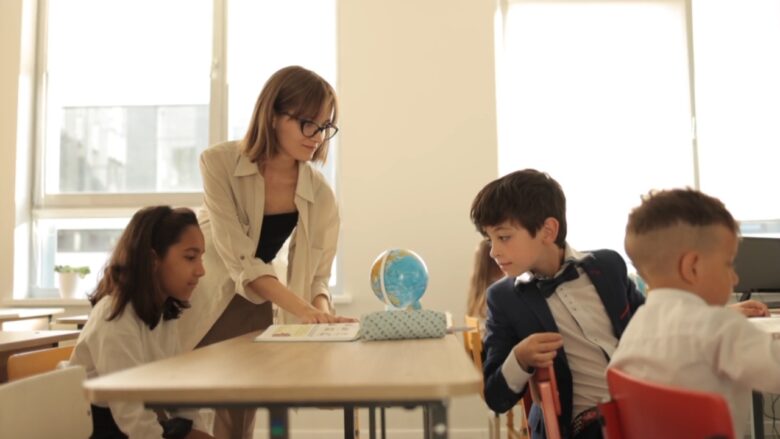

A child who keeps asking “What page?” may look distracted. Another may copy a classmate instead of following the teacher’s instructions. Someone sitting quietly at the back of the room may appear to be keeping up while regularly missing small pieces of conversation.
Hearing difficulties can affect school performance in surprisingly subtle ways. Problems may appear as weaker concentration, slower vocabulary growth, missed instructions, reading difficulties, tiredness, or reluctance to join classroom discussions.
Even relatively mild hearing loss can interfere with learning, particularly when classrooms are noisy.
A child can still perform very well academically with hearing loss. Early identification, appropriate hearing care, and sensible classroom support can make a substantial difference.
Hearing Problems Do Not Always Look Like Hearing Problems
School relies heavily on spoken information.
Teachers explain new concepts, give instructions while moving around the room, ask questions, correct misunderstandings, and casually add useful details that never appear on a worksheet.
Missing a few words may sound insignificant. During a full school day, those gaps can accumulate.
Imagine a teacher saying, “Finish questions six through nine, then underline the verbs.” A child hears “questions six…nine…underline…” and watches other students to work out what happens next. The assignment eventually gets completed, so nobody immediately suspects hearing difficulty.
Similar gaps can affect spelling, vocabulary, mathematical instructions, classroom discussions, and the ability to follow multi-step tasks.
The CDC notes that even relatively small amounts of hearing loss can affect language comprehension, communication, classroom learning, and social development.
Research discussed in its guidance on hearing loss also indicates that children with untreated mild-to-moderate hearing loss tend, on average, to perform less well academically than peers with typical hearing.
A Classroom Is a Difficult Place to Listen
An audiologist’s testing booth is quiet. A classroom rarely is.
Chairs scrape across floors. Air-conditioning systems hum. Someone whispers near the window. A lawn mower starts outside just as the teacher explains tomorrow’s homework.
Distance creates another problem. Speech becomes harder to distinguish when the teacher is several metres away, particularly when background noise competes with the voice.
Room acoustics matter as well. Hard surfaces can create reverberation, causing sounds to linger and overlap.
According to the American Speech-Language-Hearing Association’s classroom acoustics guidance, excessive noise and reverberation can affect speech perception, listening comprehension, attention, memory, literacy, numeracy, and behaviour. Children with hearing difficulties can be especially vulnerable.
A child may therefore pass along information accurately during a quiet one-to-one conversation and struggle during science class after lunch.
Listening Can Consume Considerable Mental Energy
Hearing is closely connected with cognitive workload.
When speech is difficult to hear, the brain has to spend additional effort identifying missing or unclear information. Mental resources being used to decode speech cannot simultaneously be devoted as freely to remembering instructions or processing a new concept.
Recent research adds useful context. A 2026 study of children aged 10 to 12 compared 130 children with minimal-to-mild conductive hearing loss with 130 peers with typical hearing.
Children with hearing loss showed greater listening effort and subjective fatigue, alongside poorer average academic performance.
The research was cross-sectional, so it cannot establish a simple cause-and-effect chain, yet the findings reinforce concern about the cognitive burden created by difficult listening.
Such effort may help explain an easily overlooked pattern: a child seems reasonably attentive during the morning and becomes exhausted, irritable, withdrawn, or unfocused later in the day.
Language and Reading Can Be Affected Over Time
Children learn language from direct teaching and from thousands of small encounters with speech.
They overhear conversations. They notice how teachers pronounce unfamiliar terms. They listen to classmates explain ideas in different ways. They pick up expressions during lunch or while walking between lessons.
Reduced access to speech can limit parts of that incidental learning.
The National Institute on Deafness and Other Communication Disorders explains that hearing problems can affect speech and language development, which is why a hearing assessment may be included when a child is being evaluated for speech or language delays.
Reading can also become harder for some children because spoken language provides much of the foundation for vocabulary, phonological awareness, and comprehension.
Effects vary widely. Age at onset, severity, whether one or both ears are affected, access to language, use of hearing technology, additional developmental factors, and educational support all influence outcomes.
Temporary Hearing Changes Matter Too

Permanent hearing loss receives considerable attention, yet hearing can also fluctuate.
Middle-ear problems provide a common example. Fluid may remain behind the eardrum after an ear infection, a condition known as otitis media with effusion. A child may have few obvious symptoms while sounds become harder to hear clearly.
NIDCD’s childhood ear infection guide explains that persistent or recurring middle-ear fluid can affect hearing.
From a teacher’s perspective, fluctuating hearing can be puzzling. The student follows instructions comfortably one week and repeatedly asks for clarification the next.
Changes deserve attention when they persist or begin affecting learning.
What Signs Might Appear at School?
No single classroom behaviour proves that a child has hearing loss. Several patterns together can justify a conversation with a parent, teacher, pediatrician, or hearing professional.
A child may also appear inattentive because spoken instructions were never heard clearly in the first place. Attention difficulties, language disorders, learning disabilities, sleep problems, vision problems, emotional factors, and many other issues can produce overlapping signs. Proper assessment matters more than trying to diagnose the cause from classroom behaviour alone. A formal hearing check is a sensible starting point. CDC guidance recommends hearing testing before children enter school and whenever concerns about hearing arise. Children who fail a screening should receive a complete audiological evaluation rather than relying on the screening result alone. The CDC screening guidance explains the process in greater detail. Parents can also ask teachers highly specific questions. “Does she struggle when you are across the room?” is often more informative than “Is she paying attention?” Patterns involving particular seats, noisy subjects, assemblies, group work, or afternoon classes can provide useful information for an audiologist and educational team. Support depends on the individual child, type of hearing difficulty, communication preferences, and school environment. ASHA recommends considering measures such as strategic seating, reducing unnecessary classroom noise, gaining the student’s attention before speaking, providing written or visual information, checking comprehension, and making visual cues easy to see. Hearing-assistive technology may also help. Hearing technology comes in different formats, with providers such as MedeScan offering examples of behind-the-ear and in-the-ear hearing aids, although the appropriate option for a child should be determined with professional guidance. Remote microphone systems, for example, can transmit a teacher’s voice more directly to compatible hearing devices, reducing some of the problems created by distance and surrounding noise. ASHA describes several options in its child hearing-loss guidance. Helpful accommodations are usually individualized rather than copied from a standard checklist. In the United States, hearing impairment can qualify as a disability under the Individuals with Disabilities Education Act when it adversely affects educational performance and the child requires special education and related services. IDEA regulations specifically recognize permanent or fluctuating hearing impairment. Eligible students may receive support through an Individualized Education Program (IEP), while some students receive accommodations through Section 504. For children who are deaf or hard of hearing, IDEA also requires IEP teams to consider language and communication needs, communication with teachers and peers, academic level, and potential assistive technology. The federal law sets out those considerations in its IEP requirements. Educational arrangements differ outside the United States, so families should check the rules and available services in their own school system. Poor grades rarely point neatly to one cause, and hearing difficulties deserve a place on the list of possibilities when a child’s performance, attention, communication, or classroom confidence begins to change. A student who appears distracted may be working unusually hard to piece together incomplete speech. A child who avoids discussion may simply dislike guessing what everyone said. Someone exhausted after school may have spent hours performing demanding listening work that classmates barely notice. Identifying the problem can change the picture considerably. Hearing evaluation, treatment where appropriate, better classroom acoustics, hearing technology, visual information, and thoughtful teaching strategies can improve access to learning. Children who are deaf or hard of hearing can build strong academic, social, and emotional skills and succeed at school, a point emphasized by NIDCD guidance for families.What Should Parents Do When Hearing Is a Concern?
Small Classroom Changes Can Improve Access
Schools Can Play an Active Role
Hearing Access Can Change the School Experience