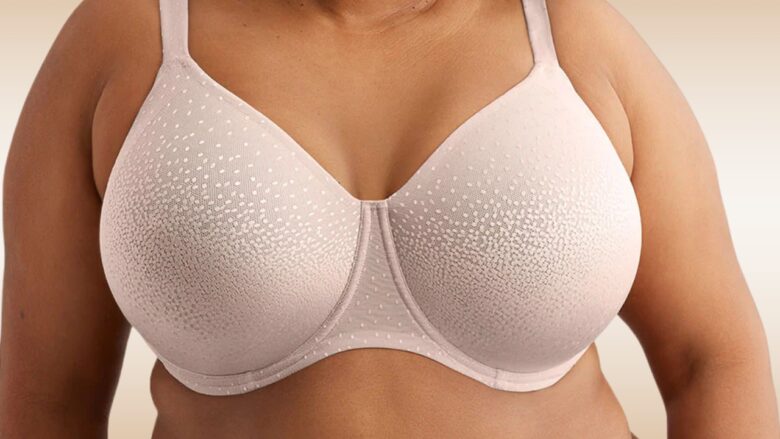
Ask ten people whether a G cup is big and you’ll get ten confident answers, most of them wrong. G cup breasts are usually described as very large, but a cup letter on its own tells you surprisingly little.
The same G cup can look dramatically different depending on the band size it sits on, the body frame, height, and breast shape, and (this is the part that trips almost everyone up) the sizing system the brand happens to use.
On a petite frame, a G cup tends to look very full and prominent. On a broader frame, the exact same cup letter can look balanced and almost understated.
Because a fuller bust carries real weight, often around one to two pounds per breast, it demands far more engineering than smaller cup sizes. Getting the fit right isn’t a nice-to-have here; it’s the whole game.
A well-fitting G cup bra improves comfort, lift, posture, and confidence, and it goes a long way toward preventing the classics: shoulder grooves, back strain, and tops that never quite sit right.
In this guide, we’ll break down what a G cup actually means, how it looks on different body types and band sizes, how to measure yourself properly (most women get this step wrong), and which bra styles genuinely support a fuller bust instead of just containing it.
What Is a Size G Bra?
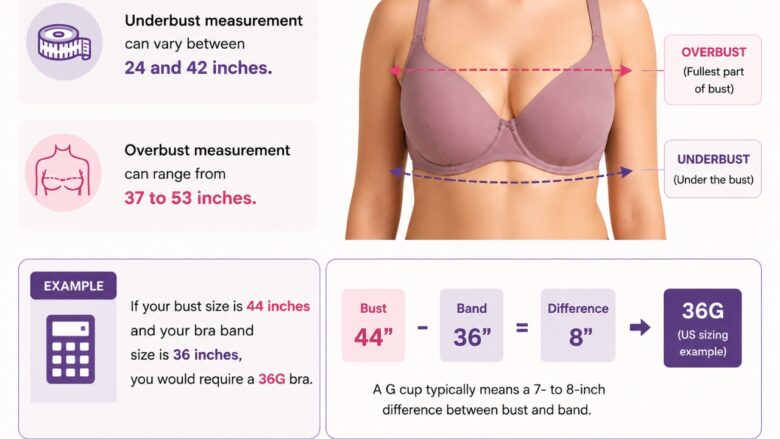
A G cup is defined by the difference between your bust and band measurements. In most US charts, that difference is about 7 inches (roughly 18 cm), which is why accurate measuring matters so much at this size.
The underbust measurement can vary anywhere between 24 and 42 inches, while the overbust measurement can range from 37 to 53 inches, which is exactly why two women who both wear a “G cup” can have completely different figures.
For example, if your bust measures 43 inches and your band measures 36 inches, that 7-inch difference points to a 36G in typical US sizing.
Note: cup letters vary by country and brand. In many US sizing systems, a G cup is often treated as about a 7- to 8-inch bust-to-band difference, while UK sizing uses extra double-letter cup steps after D, meaning a UK G is not always equivalent to a US G. Always check whether a brand uses US, UK, EU, or another sizing system before buying.
@mari_thomas_welland UK vs. USA Bra Sizing and how they’re different! So don’t get confused when you go bra shopping and make sure you’re asking for the RIGHT size from the RIGHT charts! #BraFit #BraSize #BraSizing #BraTok #BraFitting #BraCup ♬ original sound – Mari | Bra Fit Expert
Knowing your exact G bra size, in the sizing system the brand actually uses, is the difference between a bra that supports you all day and one you fight with all day.
What Do G Cup Breasts Look Like?
There is no single “G cup look.” Because the cup letter only describes the gap between bust and band, G cup breasts can appear anywhere from striking to fairly proportionate depending on a woman’s frame, height, and band size.
And while G sits toward the upper end of the cup alphabet, women who wear it are far less rare than most people assume.
Part of the confusion comes from media coverage: larger sizes are chronically underreported, and even celebrities with visibly fuller busts are routinely quoted as wearing “average” sizes such as a C or D cup.
For decades there was also a stubborn misconception that cup sizes only ran from A to D, and many women still mentally “round down” to D because that was the biggest letter they ever saw in stores.
The result is predictable: a majority of women, and especially fuller-busted women, walk around in bras that simply do not fit.
Before blaming the bra, check the numbers. Here is how to measure yourself correctly, with nothing more than a soft tape measure and a mirror: A few habits make these numbers far more reliable. Measure directly against the skin rather than over a bra, exhale normally before reading the band number, and for fuller cup sizes, lean forward at roughly 45 degrees when taking the bust measurement so the tape captures all of the breast tissue. It is also worth re-measuring once or twice a year; weight changes, hormones, pregnancy, and even a new training routine can quietly shift your size. Remember that measurement is only a starting point. A well-fitting bra should have a level band that does not ride up, a centre gore that lies flat against the breastbone, cups that neither gape nor dig in, straps that support without cutting into the shoulders, and a band that stays put when you raise your arms. If your straps leave deep grooves by the end of the day, the usual culprit is a band that is too loose doing too little of the work, not straps that are too thin. Finding clothes and bras that fit and flatter a G cup can be a genuine challenge, since off-the-rack tops are rarely cut with a fuller bust in mind. Fortunately, the market has improved enormously. Many brands now design specifically for curvier women, with features such as three-part cups, side-support panels, and reinforced bands that give G cup breasts real support rather than scaled-up guesswork. Wearing a quality bra can also help prevent chronic pain associated with larger breasts. Clinical literature on macromastia, or disproportionately large breasts, commonly discusses symptoms such as neck pain, thoracic spine pain, shoulder pain, breast pain, headaches, bra-strap grooving, skinfold irritation, and nerve-related symptoms. None of this means a fuller bust is a problem to be solved. Every body is different, and feeling comfortable in your own skin matters more than any letter on a label. With the correct bra size underneath, there is no style of top or dress that is automatically off the table. The appearance and shape of G cup breasts depend largely on the band size: the same cup letter on a 32 band and a 38 band describes two very different busts. Below is how the size tends to look across different frames, all of them genuinely G cups. If you have a band size of 32, you are likely to have a slimmer frame, often with a more defined or toned abdomen. On this body type, G cup breasts can appear quite prominent because there is less width around the ribcage to balance out the bust. As a result, a 32G bra size can create a noticeably curvy silhouette, especially from the side. However, with the right bra style, supportive straps, and a well-fitted band, this size can be comfortably supported and shaped in a flattering way. As your band size increases to 36, your breasts may appear slightly less prominent in comparison to your overall frame, even though the actual breast volume is greater than on a smaller band size. A 36G bra size often looks more balanced on a medium frame, giving the body a fuller but proportionate shape. That said, this size still requires strong support to help reduce strain on the shoulders, neck, and back. A well-structured bra with a firm band, supportive cups, and wide straps can make a significant difference in comfort. Even so, the bust remains clearly noticeable; a seven-inch difference between bust and band measurements is substantial on any frame. With a band size of 38, your breasts will appear fuller and more voluminous, but they may not necessarily look dramatically large on your body. This is because the bust is typically more in proportion with a wider ribcage and broader overall frame. For many women with a 38G bra size, the main focus is finding bras that provide lift, separation, and long-lasting comfort throughout the day. Full-coverage bras, minimiser bras, and styles with reinforced side panels can be especially helpful. Keep in mind that not all women with G cups will look the same. Factors such as height, weight, body shape, breast placement, and band size all play a role in how a G cup appears on different bodies. Plenty of famous women wear a G cup, even if the press routinely mislabels them as smaller sizes. Here are a few well-documented examples. If you share the size, their styling choices are a useful real-world reference for what works on a fuller bust. Robin Quivers is an actress, author, and American radio personality, best known for co-hosting The Howard Stern Show. Quivers underwent breast reduction surgery in 1990 but later returned to a G cup bust, as she revealed on one of her shows in 2010. Her experience highlights how breast size can change over time due to personal choices, surgery, weight changes, and lifestyle factors. Katie Price is a former glamour model who initially had a B cup size. Over the years, she underwent several breast augmentation surgeries, gradually increasing her bust size to a G cup. She later had some of her surgeries reversed, but eventually returned to a larger bust. Her changing figure has been widely covered in the media, making her one of the more recognisable celebrities associated with fuller cup sizes. Precious Lee is a trailblazer in the fashion industry, a plus-size model, and an inspiration to girls around the globe. She is also a writer and activist who uses her platform to challenge traditional beauty standards and promote size diversity. Her confident style shows how fuller busts can be embraced through bold fashion choices, well-fitted clothing, and body-positive representation. A bra that works perfectly well for a C cup often falls apart, sometimes literally, at a G. The trick is to look for styles engineered for fuller busts rather than standard designs simply scaled up. These are the types worth trying first: Research-backed sports-bra features for reducing breast movement include encapsulation-style support, padded cups, an adjustable underband, and a higher neckline. University of Portsmouth summary notes that each 1 cm increase in neckline height has been associated with about a 1% reduction in breast bounce. Furthermore, a 2024 Scientific Reports study found that, during treadmill running, both encapsulation and compression sports bras kept breast and torso movement more coordinated than running without a bra, with encapsulation showing stronger coordination than compression in that study. No matter which type of bra you choose, it’s important to find the right size and fit for optimal support and comfort. The table below shows the most common G cup sister sizes at a glance: So, is a G cup big? By most standards, yes, but as we have seen, the band size, frame, and sizing system decide how big it actually looks and feels. Finding a comfortable G cup bra starts with accurate measurements and honest fit checks, then choosing styles built for fuller busts: supportive cups, wider straps, firm bands, and fabrics that hold their shape. Done right, this takes real pressure off the shoulders, back, and chest, day after day. G cup breasts look different on every body, so the cup letter alone should never define fit, comfort, or appearance. Band size, breast shape, body frame, and plain personal preference all carry just as much weight. With a well-fitted style, a fuller bust can feel supported, balanced, and comfortable in everyday outfits, activewear, and special-occasion pieces alike. And if you are dressing for a formal event, our guide to wearing a bra with a prom dress covers strapless and low-back options that still hold up at fuller sizes. Srdjan is a staff writer at TheFrisky.How to Ensure You’ve Found the Perfect One?
Step What to Measure How to Measure Result 1 Band size Measure snugly below the bust. Note your band measurement 2 Bust size Measure around the fullest part of the chest. Note your bust measurement 3 Cup size Subtract band size from bust size. The difference determines cup size 4 G cup check Check the bust-band difference. A 7-inch difference equals a G cup G Cup Size Bust Size Band Size 30G 36-37 inches 26-28 inches 32G 38-39 inches 28-30 inches 34G 40-41 inches 30-32 inches 36G 42-43 inches 32-34 inches 38G 44-45 inches 34-36 inches 40G 46-47 inches 36-38 inches 42G 48-49 inches 38-40 inches 44G 50-51 inches 40-42 inches G Cup Size Examples
32G Bra Size
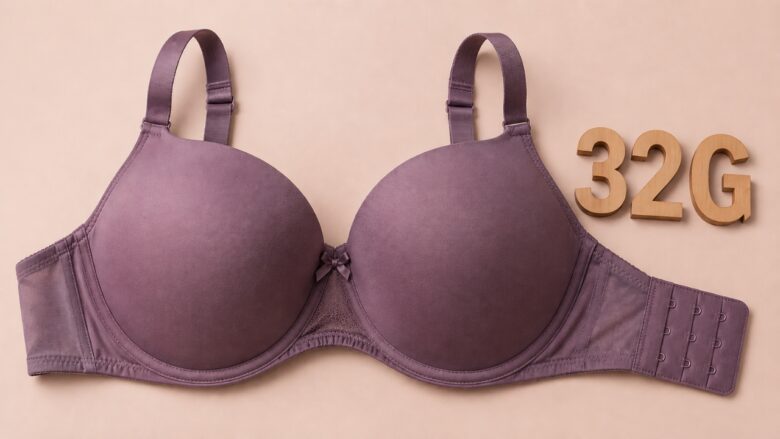
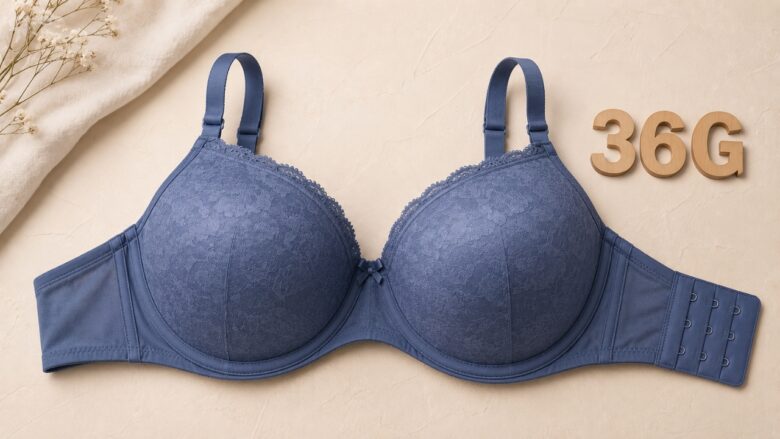
36G Bra Size
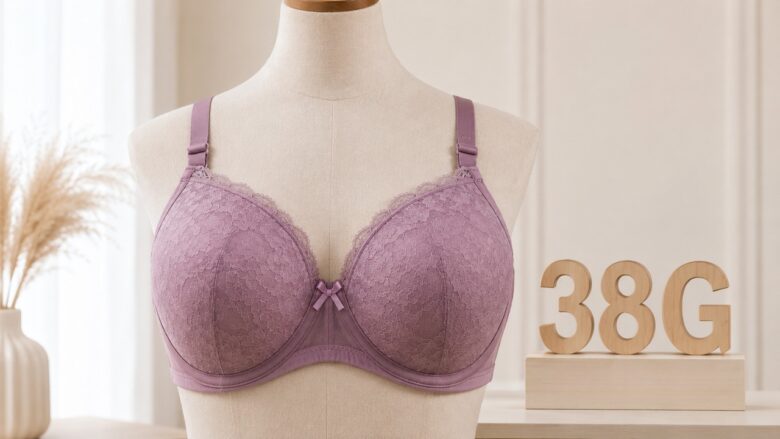
38G Bra Size
Famous Celebrities With G Cups
Robin Quivers, 34G

Katie Price, 32G
Precious Lee, 36G
Top Bras for G Cups
Bra Type Best For Key Features Support Benefits Minimizer Bra Slimmer look under clothing Structured cups, wider straps, optional underwire Smooths shape and supports fuller busts Sports Bra Exercise and active wear Supportive cups, high neckline, adjustable straps, moisture-wicking fabric Reduces movement and adds coverage Racerback Bra Daily wear or physical activity Crossed/T-back straps, often convertible, supportive design Improves posture and supports heavier breasts Frequently Asked Questions About G Cup Size
Current Bra Size Sister Size Up Sister Size Down 30G 32F 28H 32G 34F 30H 34G 36F 32H 36G 38F 34H 38G 40F 36H 40G 42F 38H Closing Thoughts