

Child support usually comes through state guidelines, not random negotiation between parents.
State guidelines usually create a starting amount, often called a presumptive amount.
Courts generally begin with that number, then decide if facts in a case justify a different amount.
Judges may adjust a guideline amount when special circumstances make the standard result unfair or inappropriate.
Parents should treat the guideline result as an important estimate, not a guaranteed final order.
So how do income, custody, and state rules actually shape the amount a parent may pay?
Who Decides the Child Support Amount?

Child support may be set by a family court, a judge, or a state child support agency.
Decision-makers usually review income records, custody details, and child-related expenses before setting the amount.
Parents may agree on a support amount, but court approval is often required before that agreement becomes enforceable.
Families dealing with divorce, custody, and support issues in Oklahoma may want case-specific guidance from divorce attorneys Tulsa parents can contact for help with local family law procedures.
An agreement that seems reasonable to both parents may still need review to confirm that it protects the child’s needs.
State guidelines usually create a presumptive amount.
A parent who wants a higher or lower amount generally must explain why the guideline result would be unfair or inappropriate.
Online calculators can estimate support, but they do not guarantee the final amount.
Final support is not certain until a court or agency approves or orders it.
Main Factors Used to Calculate Child Support
Child support calculations usually begin with financial and parenting details.
Courts look at what each parent earns, how much time each parent spends caring for the child, and which expenses must be shared.
Parent Income
Income is usually the starting point in a child support calculation.
Courts need to know how much money each parent earns or has available before applying the state formula.
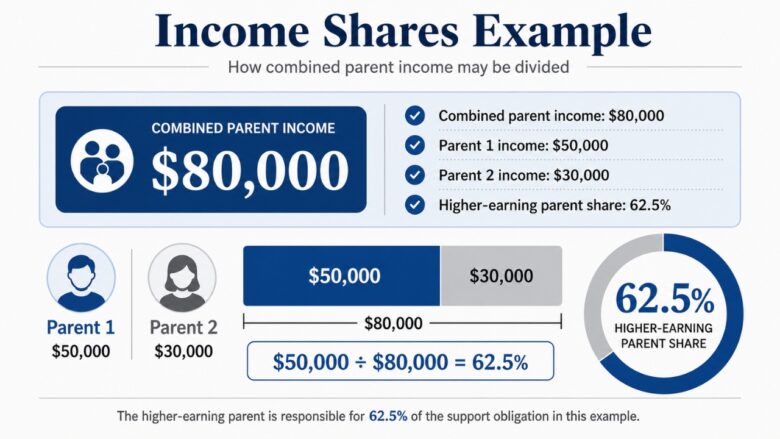
Some states count both parents’ incomes, while others focus mainly on the noncustodial or paying parent’s income. A parent with higher income, less parenting time, or a recent income increase may owe more under the guideline formula. Courts also look at records that show regular earning patterns, not just one paycheck or one month of income. Reliable records help prevent a support order based on an incomplete picture. Custody arrangements can affect the support amount. Parenting schedules help courts decide how financial responsibility should be divided between households. Overnights may reduce support in some states, especially when parents have joint custody or substantial parenting time. Shared custody does not always mean no child support, because income differences may still create a payment obligation. Custody can affect the final calculation in different ways depending on the state model used. Some formulas give parenting-time credit, while others treat custody more simply. Support usually increases when parents have more than one child covered by the order. More children generally mean higher costs for food, housing, clothing, medical care, school needs, and childcare. Actual increases depend on the state formula. Income shares models and percentage-of-income models both include the number of children in the calculation. Courts may also need to account for children covered by other support orders. Prior support duties can affect how much money a parent has available for a new order, depending on state rules. Support orders may include health insurance premiums, uninsured medical expenses, extraordinary medical costs, and work-related childcare costs. These expenses can be added to the base support amount or divided between parents. Medical support is commonly handled as part of the child support order, not as a completely separate issue. Childcare costs matter when care is needed so a parent can work, look for work, or attend approved training or education. Courts often divide those costs based on income or another state-approved method. States use different methods to calculate support. Most systems fit into a few major models, but exact results still depend on each state’s guidelines. Income shares models use both parents’ incomes. Courts estimate what both parents would have spent on the child if they lived together, then divide that obligation based on each parent’s share of the combined income. A simple income shares example shows how responsibility may be divided: Additional factors may include the number of children, medical expenses, childcare, and custody arrangements. Parenting time can also affect the final amount in states that give credit for overnights or shared physical custody. Percentage-of-income models apply a percentage to the noncustodial or paying parent’s income. Required percentages often depend on the number of children and state rules. For example, if the paying parent earns $35,000 per year and the state requires 18%, support would be $6,300 per year, or $525 per month. Custody may or may not affect this model, depending on state law. Some states adjust for parenting time, while others rely mainly on income and the number of children. Melson Formula calculations are a modified version of the income shares model. Calculations consider the basic needs of both parents and the child before assigning support. Delaware, Hawaii, and Montana use the Melson Formula. In those states, support calculations account for each parent’s ability to meet basic needs while still providing for the child. Courts do not always accept a parent’s stated income at face value. Pay records, tax documents, business records, and work history can all matter. A careful income review helps the court decide what money is actually available for child support. Special issues can arise when income changes often, comes through self-employment, or appears lower than a parent’s earning capacity. Some states use gross income, while others use net income after allowed deductions. Gross income usually means income before taxes and deductions. Net income usually means income after certain deductions allowed by state guidelines. State rules define which deductions count. Allowed deductions may include taxes, mandatory retirement contributions, union dues, health insurance premiums, or support paid for other children, depending on the jurisdiction. A proper formula should account for the ability to pay, not just a number on paper. Courts may review records carefully when a parent claims deductions or reduced income. Self-employment and irregular earnings can make child support harder to calculate. Courts may review documents that show actual earning patterns instead of relying only on reported taxable income. Judges may look closely at business expenses when those expenses reduce reported income. Some deductions may be valid for tax purposes, but may not accurately show money available for child support. Irregular income may be averaged over several months or years. Averaging can help create a fairer result when a parent’s earnings rise and fall during the year. Courts may assign income to a parent who is voluntarily unemployed or underemployed. Imputed income means the court uses earning capacity instead of only current earnings. Assigned income is usually based on work history, education, skills, local job opportunities, prior earnings, and ability to work. Courts use imputed income to prevent a parent’s voluntary choices from unfairly lowering support. Each state has its own child support guidelines. Results can vary even when parents have the same income, custody schedule, and number of children. Two primary calculation models are the income shares model and the percentage-of-income model. Exact numbers, adjustments, and documentation rules depend on where the case is filed. Parents should check the rules in their own jurisdiction before relying on an estimate. Identical facts can produce different support amounts in different states. Child support may be modified after a major change in circumstances. Courts and agencies generally require proof that the current order no longer fits the child’s needs or the parents’ financial situation. Some states may treat a 15% to 20% income change as substantial enough to support modification. Other states may require a different threshold or proof that the current order no longer matches the current facts. Parents usually need a court or agency order before the amount officially changes. Private agreements may not protect a parent if the original order still requires a higher payment. Stopping or reducing payments before approval can create arrears. Past-due support can lead to interest, enforcement actions, wage withholding, tax refund intercepts, license suspension, or other penalties allowed by state law. Child support is mainly based on income, custody, number of children, and state law. Guidelines create the starting amount, but courts may adjust for medical costs, childcare, extraordinary expenses, or unusual circumstances. Parents should gather income records, custody schedules, health insurance costs, medical bills, childcare receipts, and other financial records before estimating support. Accurate records can make the calculation clearer and help courts reach a fair result for the child.Custody and Parenting Time

Number of Children
Health Insurance and Childcare Costs

Common Child Support Calculation Models
Percentage of Income Model
Melson Formula
How Courts Determine Income

Gross vs. Net Income
Self-Employment or Irregular Income
Imputed Income
Why State Rules Matter

Can Child Support Be Changed Later?
Closing Thoughts